The digital world is evolving faster than ever. What once took weeks of planning, wireframing, and coding can now be achieved in hours with the help of artificial intelligence. AI-powered tools are transforming how websites are designed, built, optimized, and maintained. This rapid shift has sparked a common global question among businesses, startups, and even designers themselves: Is a website designer still relevant in the age of AI?
The short answer is yes—but not in the traditional sense. The role of a website designer has evolved dramatically. Today, success lies not in choosing between humans or AI, but in understanding how both work together to create faster, smarter, and more conversion-focused websites.
This in-depth guide explores the modern role of a website designer, the impact of AI on web design, global trends shaping the industry, and how businesses should choose the right website design approach in 2026 and beyond.
The Evolution of Website Design in a Global Digital Economy
Website design has never been static. From simple HTML pages to complex interactive experiences, the industry has evolved alongside technology.
In the early days, websites were purely informational. Designers focused on layout, colors, and basic navigation. As businesses moved online, websites became sales tools, brand ambassadors, and customer support platforms. User experience (UX), performance, and accessibility became just as important as visual appeal.
Today, we are in the AI-driven era of website design. Artificial intelligence has introduced automation, personalization, and real-time optimization at a scale never seen before. Businesses operating globally now expect websites that load instantly, adapt to user behavior, and convert visitors efficiently—across devices, languages, and markets.
This shift has not eliminated the need for website designers. Instead, it has redefined their responsibilities.
Who Is a Website Designer Today?
A modern website designer is no longer just someone who “makes websites look good.” The role has expanded to include strategic thinking, user psychology, and performance optimization.
Today’s website designer typically works across multiple areas:
- Understanding brand identity and translating it into a digital experience
- Designing user journeys that guide visitors toward specific actions
- Ensuring usability across devices and screen sizes
- Collaborating with developers, marketers, and AI tools
- Optimizing layouts for conversions, speed, and accessibility
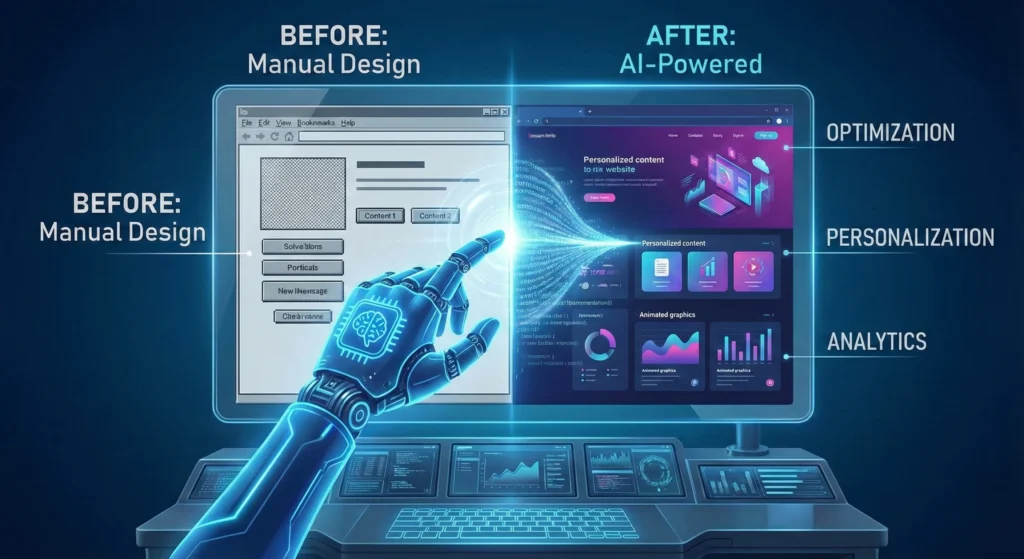
Rather than manually creating every element from scratch, designers now curate, guide, and refine AI-generated outputs. The focus has shifted from execution to decision-making and optimization.
How AI Is Changing Website Design Worldwide
AI is no longer experimental—it is mainstream. Businesses around the world are using AI to accelerate website creation and improve performance.
AI impacts website design in several key ways:
Speed and Efficiency
AI can generate layouts, content structures, and even code within minutes. What once took weeks can now be prototyped in a single day.
Data-Driven Design Decisions
Instead of relying on guesswork, AI analyzes user behavior, heatmaps, and conversion data to suggest design improvements.
Personalization at Scale
AI allows websites to adapt content, layouts, and calls-to-action based on user behavior, location, or intent—something manual design cannot efficiently achieve.
Cost Optimization
For startups and growing businesses, AI-powered website design significantly reduces development costs while maintaining quality.
According to Google’s guidance on helpful, user-focused content, websites should be created primarily for users, focusing on genuine value, clarity, and real-world usefulness rather than search engine manipulation.
Despite these advantages, AI alone cannot fully understand brand emotion, cultural nuance, or long-term strategy. This is where the human website designer remains essential.
Website Designer vs AI Website Design: Understanding the Difference
Rather than viewing this as a competition, it is better understood as a comparison of strengths.
A website designer excels at:
- Creative storytelling and brand alignment
- Understanding emotional triggers and user intent
- Designing complex user flows
- Making strategic decisions based on business goals
AI website design excels at:
- Speed and automation
- Pattern recognition
- Performance optimization
- Testing and iteration at scale
The most effective websites today are built using a hybrid approach, where designers leverage AI tools to work faster and smarter without sacrificing creativity or strategy.
When Businesses Still Need a Website Designer
Despite AI’s capabilities, there are many situations where a skilled website designer is irreplaceable.
Businesses with strong branding requirements often need a human designer to ensure consistency, originality, and emotional connection. Luxury brands, creative agencies, and storytelling-driven businesses fall into this category.
Complex platforms—such as SaaS products, marketplaces, or enterprise dashboards—require thoughtful UX design that considers user behavior, onboarding flows, and long-term engagement. These decisions go beyond automated templates.
Global businesses targeting diverse audiences also benefit from human insight. Cultural context, language tone, and visual preferences vary across regions, and designers help ensure the website resonates universally.
In these cases, AI acts as a powerful assistant, but the designer remains the decision-maker.
When AI Website Design Is the Smarter Choice
For many modern businesses, AI-powered website design is not just an option—it is a competitive advantage.
Startups launching quickly often prioritize speed and scalability. AI enables them to create professional, high-performing websites without large upfront investments.
Marketing-focused websites such as landing pages, campaign sites, and lead funnels benefit greatly from AI optimization. Automated A/B testing, content adjustments, and layout refinements improve conversion rates continuously.
Businesses operating globally also gain from AI’s ability to personalize content for different users, time zones, and markets—something difficult to manage manually.
In these scenarios, AI website design provides efficiency, performance, and measurable ROI.
The Hybrid Model: The Future of Website Design
The future of website design is not human versus machine—it is human plus machine.
In a hybrid model:
- AI handles repetitive tasks, testing, and optimization
- Designers focus on strategy, creativity, and user experience
- Businesses benefit from faster delivery and better performance
This approach allows designers to work at a higher level, while businesses receive websites that are both visually compelling and data-driven.
Skills Every Website Designer Must Learn in 2026
To remain relevant in a global AI-driven market, website designers must evolve their skill sets.
Designers today are expected to understand:
- AI-powered design tools and workflows
- Conversion rate optimization principles
- UX psychology and behavior analysis
- SEO fundamentals and performance metrics
- Automation and scalability concepts
The modern website designer is part strategist, part analyst, and part creative professional. Those who adapt will thrive; those who resist change risk becoming obsolete.
Global Trends Shaping Website Design
Several global trends are influencing how websites are designed and experienced:
AI-driven personalization is becoming standard, with websites adapting dynamically to users.
Performance optimization is critical, as users worldwide expect instant loading times.
Accessibility is no longer optional. Inclusive design ensures websites are usable by everyone, regardless of ability or device.
Headless architectures and modular design systems are gaining popularity, allowing greater flexibility and scalability.
These trends highlight the importance of combining technical intelligence with human insight.
Choosing the Right Website Design Approach for Your Business
There is no single answer that fits every business. The right approach depends on your goals, resources, and growth plans.
Businesses focused on branding and storytelling benefit from designer-led strategies supported by AI.
Companies prioritizing speed, scalability, and performance often choose AI-first website design models.
Many organizations find success by blending both—using AI to optimize and designers to guide strategy.
The key is aligning your website design approach with your business objectives, not trends alone.
The Business Impact of AI-Assisted Website Design
Websites are no longer static assets. They are living systems that evolve based on user behavior and business needs.
AI-assisted design allows businesses to:
- Launch faster
- Reduce development costs
- Improve user engagement
- Increase conversion rates
- Scale globally with ease
Designers play a crucial role in ensuring these systems remain aligned with brand identity and user expectations.
Common Myths About Website Designers and AI
One common misconception is that AI will completely replace website designers. In reality, AI replaces tasks—not thinking.
Another myth is that AI-generated websites lack quality. When guided by experienced designers, AI outputs can meet and exceed professional standards.
Some also believe AI removes creativity from design. On the contrary, it frees designers from repetitive work, allowing more time for creative and strategic thinking.
The Final Verdict: Are Website Designers Still Relevant?
Website designers are not becoming obsolete—they are evolving.
In the age of AI, relevance comes from adaptability. Designers who embrace AI tools, understand data, and focus on user experience will remain indispensable.
For businesses, the smartest approach is not choosing between AI or designers, but leveraging both to create websites that are fast, intelligent, and conversion-focused.
The future of website design belongs to those who understand that technology enhances creativity—it does not replace it.
Final Thought
The question is no longer whether a website designer is still relevant. The real question is how designers and AI work together to shape the future of the web.
Businesses that understand this shift—and act on it—will lead the digital landscape in 2026 and beyond.
Is AI replacing website designers?
AI is changing the role of website designers, not eliminating it. Designers who adapt remain highly valuable.
Do small businesses need a website designer?
Small businesses can benefit from AI-powered design, but strategic input from a designer improves results.
Is AI website design suitable for global businesses?
Yes. AI enables personalization and scalability across markets when used correctly.
What skills should website designers focus on now?
AI tools, UX psychology, CRO, and performance optimization are essential.
Is a hybrid website design approach best?
For most businesses, combining AI efficiency with human strategy delivers the best outcomes.